Dec 13th, 2009
by Donnie.
A new addition to our publications, this recipe book was originally compiled by Pairc Community Association in the late 70’s and is now reprinted by Pairc Historical Society.
The book has 44 pages of recipes including a small number in Gaelic. The recipes relate to a time when there were far less choice of ingredients that we have today. Recipes include Ceann Cropaig, stuffed fish heads, Marag Dhubh and many other local delicacies.
Posted in: at home, crofting, fishing, people.
Tagged: kershader · marvig · orinsay · pairc
Nov 19th, 2009
by Donnie.
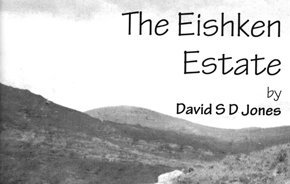
An impressive illustrated new publication about the history of the Eishken estate in Pairc, Lewis, written by well-known historian David Jones, was launched by Comunn Eachdraidh na Pairc at Orinsay Village Hall recently.
The huge extent of the peninsula of Pairc, which but for a narrow neck of land between the heads of Loch Erisort and Loch Seaforth would be an island, together with its remoteness from main population centres, and dramatic mountain and coastal scenery, have always marked it out as special. There is now growing evidence that Pairc was the private deer park of the owners of Lewis from an early date, a fact which almost certainly explains its name. The population of this vast area was probably relatively sparse up to the late 18th century when kelp and fishing began to take on greater economic importance and led to landlords encouraging local populations around the coastal fringes, perhaps for the first time. But the collapse of the kelp industry in the 19th century, together with the high rents available for a time from sheep farming, followed by the fashionable interest in deer forests during the Victorian period, transformed the position as people once again became expendable. Continue reading →
Posted in: events, land, people, photos.
Tagged: eishken
Nov 12th, 2009
by Donnie.
Title: Launch of Eishken Estate publication
Location: Orinsay Hall
Description: A New Publication on the history of Eishken Estate written by David Jones will be launched. David will also talk about the history of the Estate. All welcome. Refreshments
Start Time: 7.30 pm
Date: 2009-11-24
Posted in: Uncategorized.
Tagged: eishken · orinsay
Oct 20th, 2009
by Donnie.
Much has been written about the Highlands and Islands clearances which took place mainly from the late eighteenth century through to the mid nineteenth century. By comparison very little research has been published on the creation of new crofts and the enlargement of existing ones during the inter-war years between 1919 and 1939. A considerable number of these so called “land settlement” schemes have been undertaken on the island of Lewis. In South Lochs there were three such land settlement schemes between the two World Wars. Two of them, at Orinsay and Glen Gravir were recognised as official schemes, and the one at Steimreway was not.
Orinsay, along with Lemreway, was cleared in the 1840s, and fourteen new crofts were created there by the Board of Agriculture for Scotland (BoAS) in 1922. These remain today. Continue reading →
Posted in: Uncategorized, crofting, events, land.
Tagged: gravir · orinsay · stiomreway
The enclosed photographs are from the Estate of Mary MacIver, Verdun, Montreal ( Mairi Anndra) of 15 Gravir. Most of the photographs seem to be taken in Gravir and include family and neighbours.
Posted in: at home, children, emigration, people.
Tagged: canada · gravir · marvig · montreal
Title: Angus Macleod Memorial Lecture
Location: Pairc School, Gravir
Description: The 6th Angus Macleod Memorial lecture will take place at Gravir School – starts at 7.30 pm. The speaker is the Right Hon Charles Kennedy MP. All Welcome
Date: 2009-10-22
Posted in: Uncategorized.
Tagged: gravir
A few months ago we published an article on the Hudson bomber which crashed at Mulhagery in Southern Pairc and received the note below from Dave Earl.
‘Nice article on the Hudson. I am an aviation historian/author living E of Manchester and have for a number of years been researching losses of aircraft around the Scottish Islands for a book project. With permission of the Estate manager Chris McCrae I visited the site of the Hudson in May 2000. I also visted the graves of Rigby & Hancock in Stornoway to pay my respects. Oddly the 1180 accident card on this aircraft was never updated and it is still listed as missing. During research I am always seeking family members to try and obtain a little on a crew members background and any photos of them if available, I note that Roger Hancock left a note here and I would most welcome any correspondance with him, if you could please pass on my e-mail address I would be most grateful. He is of course most welcome to anything I have gathered in my file over the years. Many thanks Donnie once again for writing this article, it is important that we remember the sacrifices these men made for us all. Kind Regards. David W.Earl.’
Dave has now kindly sent us some photographs taken on the site when he visted with his colleague D Ramsay in May 2000.
Posted in: military, people, photos.
Tagged: mulhagery
I have just added several new photos kindly provided by Kenny Maciver to the gallery below. The feedback on the day has been excellent and many thanks to all those who made donations on the day. It is greatly appreciated.
Donnie
Posted in: Uncategorized.
Tagged: eishken
Jun 28th, 2009
by Donnie.
A great turnout at the Deer Park Raiders monument and a beautiful sunny day – John Randall spoke of the history of the deer park raids and Angus Macleod’s role in commisioning a series of cairns to commemorate the land struggles. The next stop was at Seaforth Head where Ken Roddy Mackay spoke on the history of the area and his own memories of the place. We then moved on to Eiskein and enjoyed a barbecue and a further talk on the history of the estate by John Randall. This was followed by a walk further into Eiskein estate.
Here are some photos of the day. Note that it is better to click on individual photos rather than use the slideshow
Posted in: events, land, photos.
Tagged: eishken
Jun 22nd, 2009
by Donnie.
Come and join Comunn Eachdraidh na Pairc at our annual outing which is to be at Eiskein this year. Assemble at the Deer Raiders memorial cairn at the Eiskein road end at 10.30 on Saturday 27th June. The format will be a brief talk on the history of the Deer Raiders and then a stop at SeaforthHead to hear about the history of that area and then on to Eiskein. There will be a barbecue at the boathouse around 12.45 followed by a walk into the estate. We have just had confirmation that it will not be possible to go to Steimreway by boat from Eiskein as had previously been a possibility. Everyone is welcome and there is no charge. You will be advised on the day about car parking arrangements and a minibus will be available to take people in to the estate.
See you there.
Posted in: events.
Tagged: eishken
Jun 14th, 2009
by Donnie.
When the British herring fishing industry was at it’s height it was reckoned that for every drifter that went to sea about a hundred jobs were provided on shore. We do not know how accurate that statement was but certainly the herring fishing provided a lot of jobs ashore, not least the thousands of herring gutters in every fishing port round the coast ever since large scale gutting began in Scotland early in the 19th century.
It was the Dutch that originally devised the technique of removing the gill and long gut from the herring before curing them in barrels with layers of salt between each tier of fish. That secret enabled them to monopolise the whole European herring trade throughout the 16th and 17th centuries.
The main market for Scottish herring before the 19th century was in the West Indies where fish was in great demand as a cheap food to feed the Negro slaves on the plantations and the quality of the cure for that market was not important. When slavery was abolished by the acts of 1807 and 1833 the West Indian market for herring declined and eventually ceased altogether, hence the necessity to seek new outlets for Scottish herring. Continue reading →
Posted in: fishing, trade.
Tagged: Glasgow · stornoway
May 24th, 2009
by Donnie.
AIG AN OBAIR – From an article in Tional April 1994
When I left school in Lemreway in 1934, I got a job as a postman, delivering letters to thirty-two crofts in Lemreway, thirteen crofts in Orinsay and four crofts in Stiomreway. This was a departure from the accepted custom as boys usually took a job in a fishing boat on leaving school. There were plenty of opportunities, as there were nine boats fishing our of Lemreway at the time, all requiring a crew of five adults and a boy. The boats left Lemreway on a Monday and were based in Stornoway until they returned the following Saturday morning.
Delivering the mail to Stiomreway was quite an arduous task. It was over two miles from Orinsay over rough moorland and around lochs. In those days, most of the mail comprised of catalogues and parcels from J. D. Williams and similar mail order firms. The catalogues were often ordered for the girls in the Village by boys under pet names and I became quite expert at spotting the fakes and most of them found a resting place at the bottom of the loch about a mile out of Orinsay. Stiomreway was eventually abandoned in 1941.
This occupation was only available when the regular postman was on holiday or ill. Between times, I found work at one of the road building projects going on at the time and soon felt I was well on the way to becoming a millionaire. With our newly earned wealth, five of us ordered brand new bicycles from – wait for it – J. D. Williams, of course. They cost £5 each and we paid them up at ten shillings per week or 50p in to-day’s currency. They were called ‘Flights’ and we were very proud of them. We collected a few cuts and bruises before we mastered them, but we soon got the hang of them and felt very proud of ourselves riding to Church at Gravir on Sunday, scattering the rest of the congregation as we sped by on the four-mile journey. I suppose we were as popular as the Red Arrows are to-day. Continue reading →
Posted in: church, communications, fishing, people, trade, transport.
Tagged: gravir · lemreway · orinsay · stiomreway
May 17th, 2009
by Donnie.
‘Leac-na-Gillean‘ is remembered in the traditions of lochs as the geographical feature where the Press-gang put 32 young local men on board small boats against their will and ferried them out to a waiting warship that was hiding behind the Island of Tabhaid at the mouth of Loch Erisort. Subsequently 12 of them returned but 20 of them were never seen again. Leac-na-Gillean is at Swordale bay near Keose on the southern shores of Loch Leurbost. It was at Swordale Keose that the first Presbyterian Parish Church for the whole of the Parish of Lochs was built in 1724, and about the turn of the 18th/19th centuries, the church and manse buildings were moved up to the village of Keose. The new church stood where the Seaweed Factory was sited and the manse may still be seen at Glebe, Keose where it is used as a dwelling house. According to tradition the young men were lured into a trap under false pretences by causing them to enter the old parish church building at Swordale where the hated press gang were lying in wait for them, either within the church or nearby, ready to pounce on them and carry them away and enlist them in one of the armed services, probably the Navy seeing a warship was used.
Local tradition give two dates for this event 1802 and 1808 and furthermore it was said that it was during the ministry of Rev. Alexander Simpson the Parish Minister who was at Lochs from 1793 to 1830 which was during the time of the Napoleonic Wars, that the young men were taken. One source give the dates of the building of the new church and manse as 1796 for the church and 1800 for the manse, but we have seen slightly later dates given, 1808 seems rather late as the date of the Press Gang, as the new church was probably in use by then. On the other hand the old thatched church might have been used on occasion as well.
It is implied that Rev. Alexander Simpson was involved in the luring of the young men to the church and that whiskey played a part, but we would expect folk-lore to add colour to the event and no one knows what, if any part the well known minister played in the episode.
A late Crossbost Free Church Minister seemed to be well aware of the details of the event, but unfortunately we do not know if he could identify any young men that were involved in the event. Some Keose sources are inclined to think that possibly some or all of the men were in the North Lochs area rather than the Kinloch area.
We would be grateful for any more information about the 32 young men.
Posted in: church, military, people, tales.
Tagged: keose · lochs
May 10th, 2009
by Donnie.
The small crofter settlement of “Brinigil” or “
Bruinigeal” not far from Seaforth-Head, on the shores of inner Loch Seaforth, is noted in local tradition as the place at which the incident or legend which gained its crest for the Seaforth Highlanders Regiment.
In confirmation of this local tradition it is maintained that a painting could be seen hanging in one of the rooms of Brahan Castle, when it was occupied, depicting the king in the act of rising from the ground while close behind him a bare-armed kilted figure could be seen holding a stag by the antlers, and in the background a lady was seen to be calling “Cuidich ‘n Righ“, {Help the King}. At the foot of the picture was the locus of the incident given as “Brinigil” on the shores of Loch Seaforth.
Posted in: events, military.
Tagged: seaforth head
SABAID MOR WICK
The Wick riot which took place in August 1859 between Lewis fishermen and East coast fishermen was a ‘free for all’ that lasted a whole week. Although perhaps relations between East Coast fishermen and Hebridean fishermen may not have been too good, it was a dispute between two lads over an apple, a lad from Wick and one from Lewis that started the “Sabaid Mor”
Police apprehended the 14 year old Lewis lad, Malcolm Macleod “Calum Alastair“, 2 Habost, Lochs who was helping in his father’s boat. Skipper Alastair had moved from Balallan to Habost to take the place of a family that was evicted and moved away to Harris by the notorious factor Donald Munro.
Hundreds of people were engaged on each side in the fight and some Lewismen were arrested and taken to jail and this action by the police aggravated the situation. Domhnull Ruaridh Mackenzie, 10 Laxay, assisted by his crew and others removed the mast from his boat and used it as a battering ram against the jail door and released the prisoners. Almost every village in Lewis were represented in the riot and some of the men were stabbed and many hurt while some on both sides were given a ducking in the harbour.
An unusually strong man from Keose played a prominent part, Rob MacDhòmhnaill 12 Keose “Mac Domhnuill Bhan“, one of his roles was to provide ammunition for the rioters by breaking up barrels and supplying staves. In the end the local authorities called in the military and Rev George Mackay of Tongue and peace was restored just before the end of the fishing season. A warrant was issued for the arrest of the strong man from Keose, Robert Macdonald and in order to evade the police he fled immediately first on foot, but he had not gone far when he was overtaken by a carriage and pair. MacDonald’s signal for a lift was ignored and as a consequence he ran after the carriage and jumped in and ejected the driver and his passenger and left them by the roadside. By the time the horses became exhausted he was near Poolewe, where he got the ferry “Mary Jane” to Lewis but the Lewis police were informed and Macdonald had to go into hiding with friends in Cromore until he thought the furore had died down. Back home in Keose he soon joined the other youths who used to gather in the manse kitchen with the servants. One evening the Stornoway police turned up and arrested Rob and handcuffed him to one of the officers. Near a Loch outside the village Rob said he was not going any further and asked the police to release him, when they refused he threatened to drag the officer to whom he was handcuffed into the Loch. After a brief struggle the officers felt they were no match for Rob and decided to release him to the delight of his friends, a large number of whom had gathered to give moral support to Rob. Knowing that he was a marked man he decided to leave via Tarbert to resume his seafaring career, this time in the Merchant Navy. Alas a few years later he was lost in the Thames Estuary.
Posted in: events, fishing, military.
Tagged: balallan · cromore · habost · keose · laxay · stornoway · wick